-
Press Release - Belgium risks missing out on 27 million euros in investment in charging points and renewable energy
The electric mobility sector warns that Belgium’s failure to transpose the European Renewable Energy Directive (RED III Transport) threatens to slow down further electrification. The deadline for this had already passed on 21 May 2025. The sector is therefore calling on the government to urgently press ahead with its implementation. A year and a half later, Belgium – and, by extension, the sector – still has no prospect of a legislative framework. This situation could have significant financial consequences should Europe initiate infringement proceedings. Meanwhile, the market value of e-credits (also known as HEE-F credits), which charging operators receive for supplying renewable electricity, has fallen sharply, and in the absence of the transposition of RED III Transport, it is continuing to decline. This is a direct blow to investment certainty for charging point operators and the charging price for end users, resulting in a flight of projects abroad. According to calculations by EV Belgium, charging point operators have already missed out on more than €4 million in investment capital in 2026 due to the government’s failure to reach a decision. By the end of 2027, this figure will rise to more than €27 million – funds that cannot therefore be reinvested in the further expansion of the charging network.
Read more about "Press Release - Belgium risks missing out on 27 million euros in investment in charging points and renewable energy"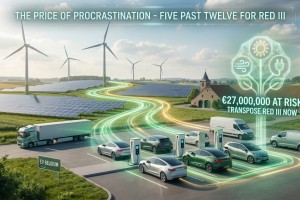
-
Opinion: Five past twelve for RED III Transport. The Price of Procrastination
In September, for the first time, more than half of all new cars were fully electric (50.9 per cent), and by the end of 2026, one in ten cars on our roads will be electric. But right now, a largely overlooked political file threatens to slow down the next phase: the transposition of the transport targets set out in the most recent revision of the European Renewable Energy Directive, also known as RED III Transport. The deadline for this transposition expired on 21 May 2025. A year and a half later, Belgium still has no prospect of a legislative framework. Meanwhile, the value of the e-credits (also known as HEE-F credits), which charging point operators receive for supplying renewable electricity, is now virtually worthless, and in the absence of the transposition of RED III Transport, it is falling further. This is a direct blow to investment certainty for charging point operators and to the charging price for end users. According to calculations by EV Belgium, charging point operators will already lose more than €4 million in investment capital in 2026 due to the government’s failure to reach a decision. By the end of 2027, the cost will rise to more than €27 million – funds that cannot be reinvested in the further expansion of the charging network, jobs and lower charging prices for Belgian end-users.
Read more about "Opinion: Five past twelve for RED III Transport. The Price of Procrastination"
-
Press release - A historic milestone of 50% EV sales, continuity is now crucial
According to FEBIAC, for the first time, more than one in two newly registered passenger cars in Belgium were fully electric. EV Belgium describes September’s figure of 50.9% as a historic turning point, but not an end point. The figures show that a consistent policy, a growing range of vehicles and years of investment in charging infrastructure are yielding results. The sector federation’s message is therefore clear: maintain continuity and focus future policy efforts on making electric driving accessible to more families and businesses – for families through private leasing, a stronger second-hand market and social leasing, and for businesses through the electrification of vans and lorries, an area in which Belgium lags behind its neighbouring countries.
Read more about "Press release - A historic milestone of 50% EV sales, continuity is now crucial"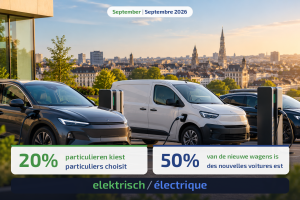
-
Opinion: The Belgian transport sector is losing ground. Cheap diesel won’t solve that.
Brussels, 25 September 2026. – Belgium has just about everything it needs to be, and remain, a European logistics champion. We are situated at the heart of Europe, have world-class ports, major distribution centres and, in Liège, a major European hub for air freight and e-commerce. So there is certainly no shortage of goods to transport. Last year, the flow of goods by road between Belgium and France alone totalled nearly 56 million tonnes, making it one of the three largest bilateral transport flows in Europe. Yet our hauliers are losing ground. The international transport performance of Belgian lorries fell by around 36 per cent between 2010 and 2024. Belgium is not alone in this. Dutch hauliers lost 37 per cent over the same period, French hauliers 26 per cent and German hauliers as much as 46 per cent. On the other side of Europe, the opposite has happened: international transport by Polish lorries has almost doubled since 2010. This is significant now that the price of diesel is once again weighing heavily on this sector. The instinct to protect our transport companies is understandable. But if we want to improve their competitiveness in the long term, we must dare to look beyond the price of diesel.
Read more about "Opinion: The Belgian transport sector is losing ground. Cheap diesel won’t solve that."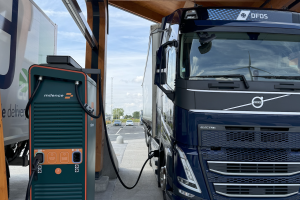
-
Press release - From 2030, Belgian drivers will save more than €1.8 billion a year thanks to electrification
Prices at the pump are high once again: on 10 September, the official maximum price stood at €2.356 per litre of B7 diesel and €2.058 per litre of 95 E10 petrol (FPS Economy). For EV Belgium, this trend confirms that the transition to electric mobility is no longer merely a climate issue, but also, increasingly, a matter of purchasing power, energy policy and geopolitical independence. During the presentation of its new 2030 Charter, the sector federation stated that a fleet of two million electric vehicles by 2030 is thus becoming increasingly realistic, and represents an achievable vision for the future if the right political choices are made today.
Read more about "Press release - From 2030, Belgian drivers will save more than €1.8 billion a year thanks to electrification"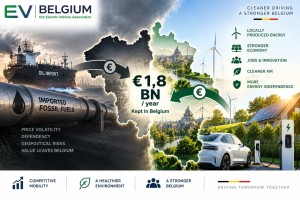
-
Opinion: Electric vehicles are taking the lead – almost one in two new cars in August were fully electric
Brussels, 2 September 2026 – The Belgian car market has reached a new tipping point. After fully electric vehicles (BEVs) continued to gain ground throughout 2026, electric vehicles overtook petrol as the most registered powertrain for the first time in June. This trend continued in July and was confirmed even more strongly in August: 46.2 per cent of all newly registered passenger cars were fully electric. This makes BEVs the most popular powertrain on the Belgian new car market for the third month running and sets yet another monthly record.
Read more about "Opinion: Electric vehicles are taking the lead – almost one in two new cars in August were fully electric"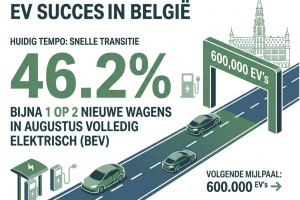
-
Press release - EV Belgium calls on the federal government to introduce a social lease scheme
EV Belgium is calling on the federal government to work towards establishing a Belgian social leasing scheme for electric cars, both new and second-hand. Following the electrification of the company cars, all private users – including those with low incomes – must now also be able to opt for cheaper and more sustainable mobility. According to the federation, families can easily save more than 700 euros a year by making the switch. For EV Belgium, electric driving is not only the most economical, geopolitically responsible and ecological, but also the most socially responsible choice — in contrast to a reduction in excise duties on petrol and diesel.
Read more about "Press release - EV Belgium calls on the federal government to introduce a social lease scheme"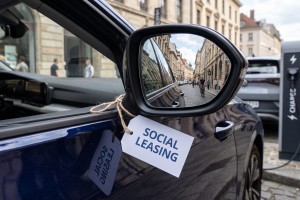
-
Opinion: Electric driving is the only socially responsible transport policy; cheap petrol is not
Whenever petrol prices approach or exceed two euros per litre, the political response is the same as always: cut excise duties, bring down the price at the pump, and make petrol and diesel cheaper. That’s understandable. But today, it’s the wrong response to a legitimate concern. After all, those who are currently hardest hit by high fuel prices also stand to gain the most from switching to electric vehicles. Not from a measure that makes fossil fuels cheaper for everyone, but from access to a technology that is structurally cheaper to run.
Read more about "Opinion: Electric driving is the only socially responsible transport policy; cheap petrol is not"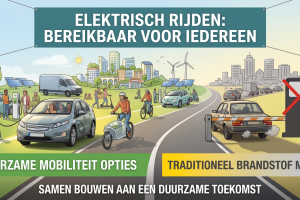
-
Opinie: Het wegenvignet is niet het probleem. Het ontbreken van een plan voor elektrische mobiliteit wel
Vlaanderen, Wallonië en Brussel hebben een politiek akkoord bereikt over de invoering van een digitaal wegenvignet. Vanaf mei 2027 zullen automobilisten jaarlijks tussen 90 en 100 euro1 betalen om gebruik te maken van de gewest- en autosnelwegen die over een recent voertuig beschikken. EV Belgium spreekt zich vandaag niet uit over het principe van zo'n wegenvignet. Dat ook buitenlandse weggebruikers bijdragen aan het onderhoud van onze infrastructuur, is op zichzelf een verdedigbare beleidskeuze. De fundamentele vraag is een andere: welk signaal wil de overheid hiermee geven over de mobiliteit van morgen? Voorlopig is dat signaal bijzonder onduidelijk.
Read more about "Opinie: Het wegenvignet is niet het probleem. Het ontbreken van een plan voor elektrische mobiliteit wel"
-
Persbericht – 20.000 extra laadpunten in 6 maanden tijd: Belgische laadpalensector zet ijzersterke groei voort in 2026
Brussel, 9 juli 2026. – De Belgische laadpalensector kende opnieuw een eerste halfjaar met ijzersterke groei, ook in Wallonië. Eind juni waren er in ons land 126,045 publieke laadpunten voor elektrische voertuigen beschikbaar, een toename van bijna 20.000 laadpunten ten opzichte van eind 2025. Tegelijk werd in juni 2026 – mede dankzij de energiecrisis – de elektrische auto de bestverkochte motorisatie op de Belgische automarkt (38%)
Read more about "Persbericht – 20.000 extra laadpunten in 6 maanden tijd: Belgische laadpalensector zet ijzersterke groei voort in 2026"

